







English
In the field of small construction, farm renovation, and landscape engineering, mini wheel loaders have become mainstream lightweight operation equipment. Many users ignore the core structural advantage that determines the overall performance of mini loaders — the articulated frame design. Different from rigid integral frame loaders, the articulated frame structure completely optimizes the loader’s flexibility, stability, site adaptability, and service life, becoming the key to efficient operation in narrow and complex working scenarios.
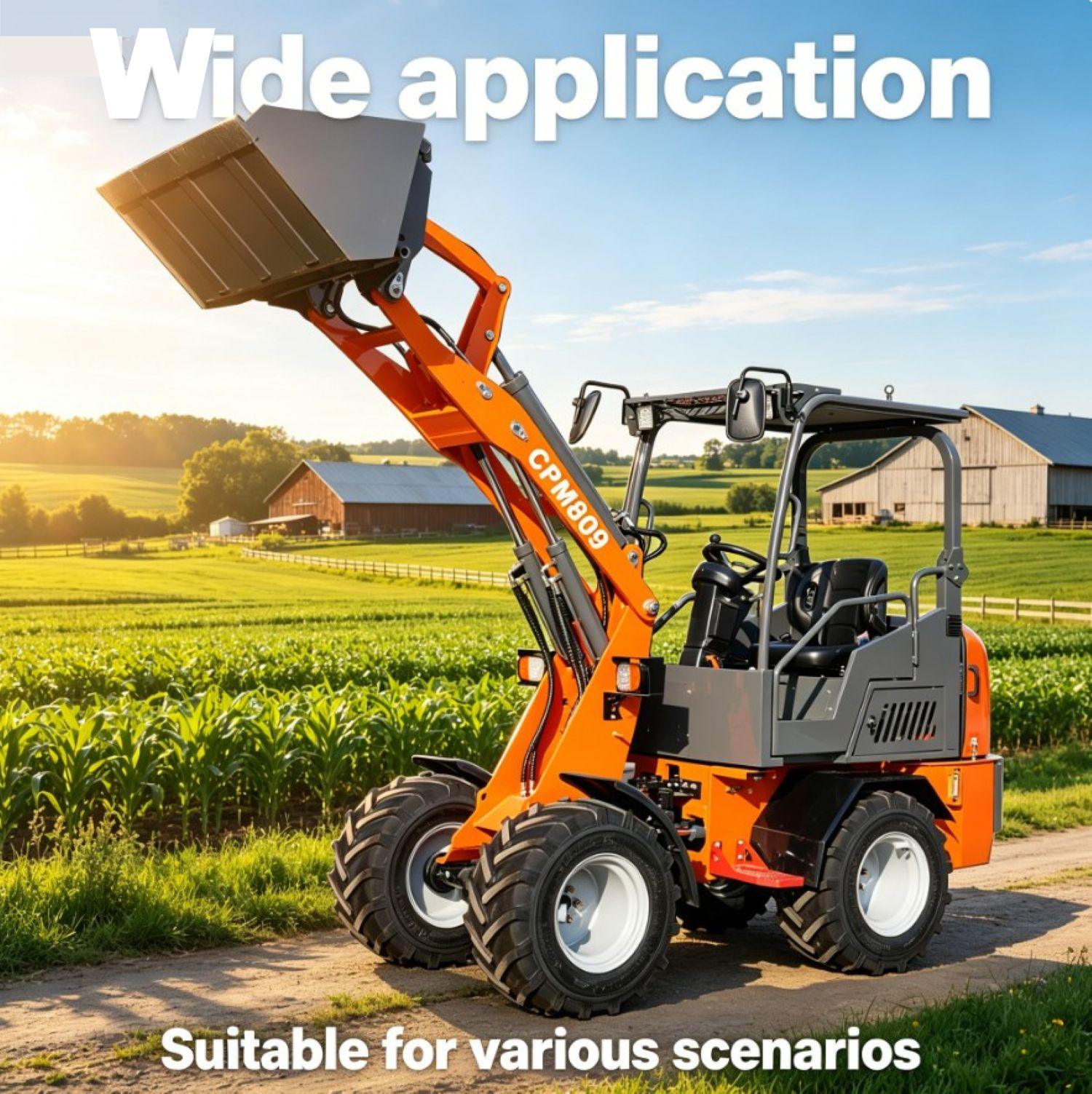
The biggest advantage of the articulated frame lies in its ultra-flexible steering performance. The front and rear fuselages are connected by a central hinge point, realizing independent deflection steering of the front body. This design greatly shortens the wheelbase and reduces the minimum turning radius, enabling the mini loader to flexibly shuttle in narrow farm passages, residential construction gaps, or dense garden environments. Unlike rigid-frame loaders that require large turning space and are prone to tire side slip and ground damage, articulated loaders complete in-situ steering and flexible direction adjustment efficiently, improving working efficiency in limited-space scenarios by more than 30%.
In terms of driving stability and terrain adaptability, the articulated frame shows outstanding advantages in complex working conditions such as uneven ground, slopes, and undulating construction sites. The central hinge structure allows the front and rear wheels to fit the ground independently. When the body passes through bumpy roads, the four wheels can maintain continuous ground contact and stable grip, avoiding empty wheels, slipping, and body jitter caused by uneven force. This structural feature effectively reduces the center of gravity offset during operation, ensuring stable lifting and shoveling operations even when carrying full load materials, and greatly improving construction safety.
For daily operation and loss control, the articulated frame design reduces mechanical wear and maintenance costs. During steering and walking, the fuselage deflects through the central hinge, and the tires roll and steer naturally without forced friction and lateral extrusion. It effectively avoids serious tire wear, chassis torsion, and structural stress concentration problems common in rigid loaders. The overall stress of the whole machine is uniform, the loss of chassis and transmission components is reduced, and the service life of the equipment is significantly extended.
In addition, the articulated frame matches the multi-functional positioning of mini wheel loaders perfectly. Its flexible body coordination ensures stable operation when switching various attachments such as buckets, forks, sweepers, and augers. Whether it is farm material handling, construction gravel shoveling, municipal road cleaning, or garden land renovation, the body can maintain balanced stress and accurate operation, giving full play to the multi-purpose advantages of one machine with multiple tools.
Many low-cost mini loaders on the market adopt simplified rigid frame structures to reduce costs, with poor flexibility, easy slipping, high wear rate, and poor adaptability to complex sites. In contrast, standardized heavy-duty articulated frame loaders take site practicability and long-term economy as the core, balancing flexibility, stability, and durability.
To sum up, the articulated frame is not a simple structural design upgrade, but a core configuration that comprehensively improves the comprehensive performance of mini wheel loaders. It is the key reason why high-quality mini loaders can adapt to diverse complex scenarios, maintain efficient and stable operation, and create higher economic benefits for users.
Address:No. 268 Yuhe Road,Weifang City, Shandong Province China.
Email:davidcp712@gmail.com
©2009-2026 Weifang CP Machinery Co.,LTD. All Rights Reserved. Privacy Policy | Terms of use |